
















From in-house development to outsourcing, enterprises often rely on software systems for daily operations. To streamline operations and make smarter decisions, enterprises are switching to Power Apps and Traditional Application development.
Complying with regulations and industry trends, Power Apps and Custom Software Development are proven to be the best choice for software development. By offering endless integration, faster resolution, and flexibility, Power Apps and Traditional App development provide high-standard solutions.
From offering numerous solutions, enterprises often struggle to make the right choice to begin their digital journey. So, to clear this out and to bring clarity, we have derived a detailed blog on Power Apps vs Traditional App Development.
Let's start with what they are, their differences, and how you can make the right choice for your digital journey.
What is Power Apps
Power Apps is an AI-integrated module of the Microsoft Power Platform that helps users to develop customized applications using a low-code base. As a flexible platform for software development, users can utilize its pre-built templates to build smarter UI and scalable applications more quickly with zero code knowledge.
By offering complete flexibility for customization, it also supports various integrations natively with Microsoft 365, Dynamics 365, SharePoint, Dataverse, and other third-party services. With the platform offering faster deployment, support, and innovative features, it empowers business users, analysts, and IT teams to collaborate in developing smarter applications without writing extensive code.
What is Traditional App Development
Traditional app development is the common idea that every user knows about software development. It involves building applications using programming languages and frameworks such as Java, .NET, Python, JavaScript, React, Angular, etc. The traditional app development provides full control over your application's architecture, performance, user experience, and integrations. This way, you can have full visibility over your application weaknesses and strengths.
As an essential part of software development, traditional app development can deliver customized applications that offer digital solutions that meet enterprise goals. However, they deliver custom solutions, they tend to have moderate to longer development cycles, making software that is perfect and delivering high-standard solutions.
Why Businesses Should Choose Power Apps
As both platforms have their own uniqueness, here is why you should go with Power Apps:
Faster Delivery: Power Apps is best suited for enterprises that need faster application delivery with minimal investment and to reduce IT team dependency.
Easy Maintenance: By reducing the IT dependency and providing faster deployment, the Power Apps reduce the technical overhead for your application at the time of updates and enhancements.
Lower development cost: The low-code platform eliminates the need for larger code bases and the dependency on large development teams.
Strong ecosystem & Integration: Bringing flexibility to software, Power Apps gives you seamless connectivity with its in-house products: SharePoint, Teams, Excel, Dynamics, and Azure, and third-party services.
Encourage Non-IT Developers: The platform enables any non-IT members to develop a killer software application by relying on a pure idea. With this, Power Apps enable enterprises to reduce the IT dependency and welcome new talent.
Agile Operation: For internal productivity tools and workflow optimization, Power Apps enables organizations to move from idea to deployment in days rather than months, making it a strong choice for agile operations.
Built-in security and compliance: The advanced AI implementation and robust security support of Power Platform help enterprises in data loss prevention, authentication, and role management.
Why Businesses Should Choose Traditional App Development
Traditional development can be beneficial for businesses when they require advanced customization, optimization, or complex integrations. To handle high volumes, real-time processing, or regulatory compliance, enterprises need the help of custom-built traditional app development.
Besides the above, here are some top reasons why businesses should choose Traditional app development:
Legacy Modernization: Organizations choose traditional development when their legacy applications need global scalability, support a high-count audience, or need modern application integration with their systems.
Complete architectural control: With traditional app development, developers can build a customer-centric application easily with full access to the admin. This way admin can track every progress and functionality of the platform for audit and other purposes.
High scalability and performance: Suitable for enterprise-grade, high-load applications.
Unlimited customization: By optimizing the code base, traditional app development offers easy customization. This way, enterprises can often modernize their IT systems more easily and tackle complex workflows and specialized business logic.
Technology independence: Organizations are not tied to a specific platform vendor.
Advanced integrations: Enables deep integration with legacy systems and proprietary tools.
Long-term Support: With the product being compatible with customization, traditional custom software applications can last long with minimum maintenance. Ideal for products that will evolve over several years.
Power Apps vs Traditional App Development: Key Differences
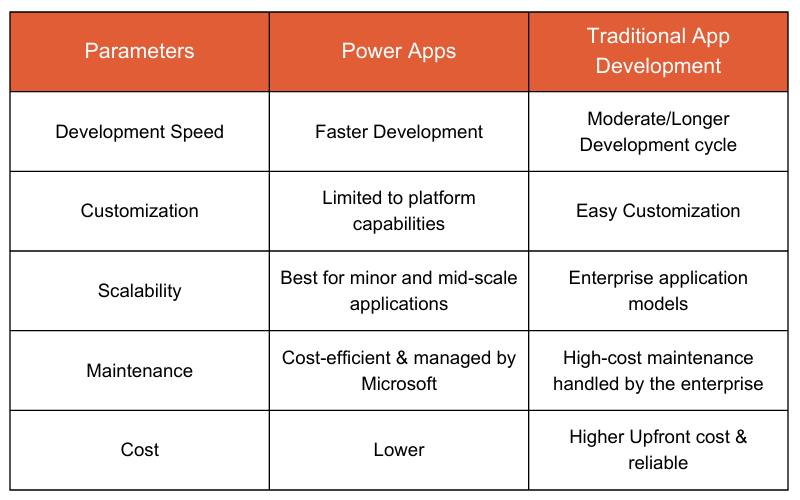
Power Apps prioritizes efficiency and accessibility, while traditional development prioritizes precision and extensibility. With a variety of separations, here are a few common differentiations between them.
How to Make the Right Choice For Your Software Needs
Choosing between Power Apps and traditional app development is decided based on the project requirements. From business value, speed, long-term impact, and other parameters, choosing a software development approach is very critical to building a high-standard application.
Enterprises that need an innovative application in a shorter span, Power Apps can be a good choice. With the platform AI-coding and low-code support, speed up the development and deployment easily. Moreover, being faster, the upfront investment for Power Platform is very low, benefiting enterprises who decided on cost-cutting.
Whereas Traditional app development is ideal for long-term investments. With the initial cost being higher, it will benefit enterprises in the long run with high-standard and smarter application models. From handing over complete control to developing mission-critical platforms, traditional app development fosters scalable infrastructure solutions. Enterprises that wish to reduce the maintenance and are willing to pay a higher upfront cost, Traditional App development is a great choice.
So, make the right choice to empower your enterprise operation and software needs. For more in-depth knowledge of custom software development and Power Platform, visit our Insights.