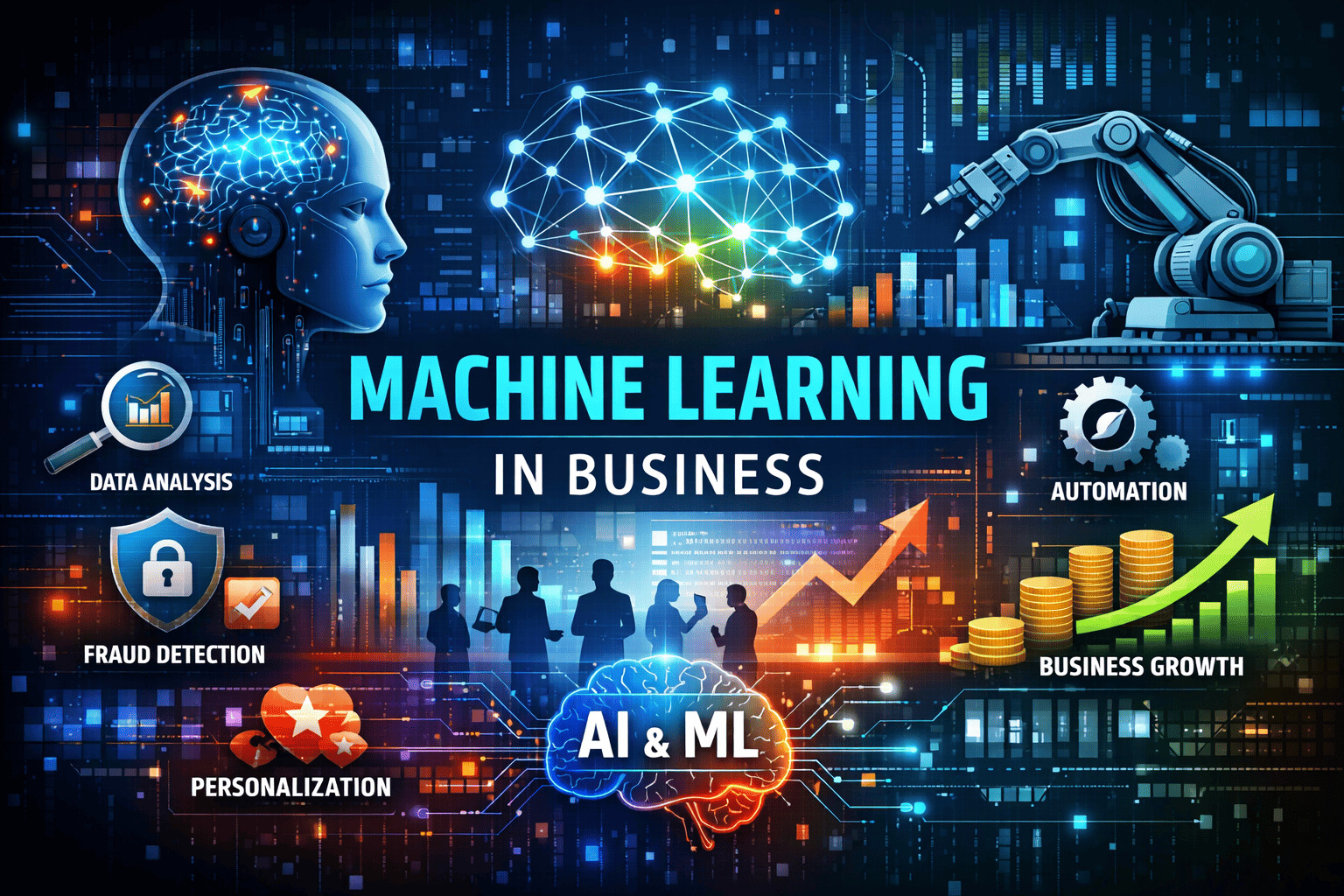



















Among various technology models, Machine Learning has been kept in the dark among enterprise application models. With AI and Power Apps streamlining enterprise operations, brands haven't realized the true power of Machine learning for business growth. Believed to be an experimental platform, businesses are actively adopting Machine Learning models for their AI and other agents to improve task outcomes.
So, let's uncover what is Machine Learning, its use cases, advantages, and how it is practical for business growth.
What is Machine Learning
Machine Learning (ML) is a subset of AI that enables AI models and agentic systems to learn data, identify patterns, and make decisions with less intervention. By eliminating rule-based programming, ML models analyze data to generate and predict data volumes for decision-making.
In enterprises, Machine Learning is not just an algorithm; it is a module that helps businesses to harness key insights and predict data to take action. Moreover, enterprises use ML to extract intelligence from datasets, automate decisions, and optimize outcomes across operations. The key value of the model lies in its predictive and adaptive capabilities for teams to empower internal operations.
Use Cases of ML in Businesses
Personalization and Recommendation
From analyzing huge data sets and predicting user preferences, ML models can bring enterprises high-level actionable insights. With this potential insight, businesses can tailor their customer service strategy to improve customer engagement, lead conversion, and customer experience to retain and strengthen customer loyalty.
Data Prediction and Forecasting
As a valuable tool to analyze historical data, enterprises can utilize ML models to analyze historical data and external variables. This way, businesses can optimize inventory, reduce wastage, and align supply with real-time market needs, improving overall operational efficiency.
Fraud Detection and Risk Management
By providing predictive data and valuable insights, ML systems can do much more by identifying unusual patterns and anomalies, enabling real-time protection. With continuous data monitoring and prediction, businesses can adapt and stay ahead of evolving threats.
Intelligent Process Automation
One of the brilliant and yet effective capabilities of Machine Learning is its cognitive decision-making. With businesses integrating ML with automation, teams can reduce manual intervention, improve operational speed and consistency, and allocate resources to strategic activities.
Key Advantages of Machine Learning for Business Growth
Decision Making
To empower enterprise operations and to make necessary development initiatives, enterprises deal with large customer and market datasets. By providing validated insights, uncovering marketing trends, and more, it helps teams to make data-backed decisions for growth. With ML models helping leadership teams to make proactive, high-confidence decisions, businesses can reduce uncertainty and strengthen strategic planning for scalable growth.
Empowering Customer Experience
From generating key insights to analyzing trends, Machine Learning models transform how businesses interact with their prospects. With ML learning user behavior, preferences, and engagement patterns, it helps outreach teams tailor offers, communication, and services in real time. Through personalized outreach efforts, brands can improve customer satisfaction, build trust, reduce churn, and create loyal customers.
Operational Efficiency
When it comes to team growth and workflow automation, brands look to invest in a killer ML model to optimize their efforts. From refining operations, streamlining repetitive tasks, speeding up workflow, and deliver high-accuracy with minimum intervention, ML offers flexibility and efficiency in operations. This efficiency not only lowers operational costs but also enables teams to focus on high-impact initiatives and organizational performance.
Competitive Advantage
From addressing customer queries to lead conversions, every business operation must happen more quickly for development. To reduce response time to tailoring responses, Machine Learning offers a competitive space for enterprises. By offering real-time insights and continuous optimization, ML gives businesses the edge to outperform competitors who follow traditional practices.
Continuous Improvement
Machine learning models evolve continuously by learning from new data inputs and feedback loops. This ensures that systems remain relevant, accurate, and aligned with changing business environments. Unlike static systems, ML-driven solutions adapt to shifts in customer behavior, market trends, and operational conditions. This ongoing refinement allows businesses to maintain performance consistency while improving outcomes over time, making ML a dynamic and future-ready capability.
Challenges in Implementing Machine Learning
From being an effective player in the data game, Machine Learning can be ineffective if it is done wrong. Here are a few important challenges that enterprises face when implementing Machine Learning in enterprise workflows.
Data Quality and Availability
ML models can be efficient when they are built and trained the right way. When brands integrate inconsistent, incomplete, or biased data, the model can deliver inaccurate predictions and failed insights.
In real time, various businesses struggle with siloed data systems, making it difficult for them to prepare a secure ML model for their growth. To overcome this challenge, enterprises should establish strong data governance and integration frameworks to achieve overall data growth and success.
Implementation Complexity
Deploying ML models into production environments requires more than technical expertise. It involves integrating models with existing systems, ensuring scalability, and maintaining performance.
Organizations often underestimate the complexity of operationalizing ML, leading to stalled projects or underutilized models. A clear strategy, supported by the right tools and infrastructure, is critical.
As a key development initiative, Machine learning can bring tangible business value for businesses when it is trained and optimized well to your business intelligence. While there are imminent challenges in implementation, they can be resolved with the right strategy and infrastructure. If you wish to settle for a Machine Learning model to empower your data analysis and growth, it's imperative to understand that it's not a technological solution in your stack. It's an intelligent system that learns from you and grows with you.