


















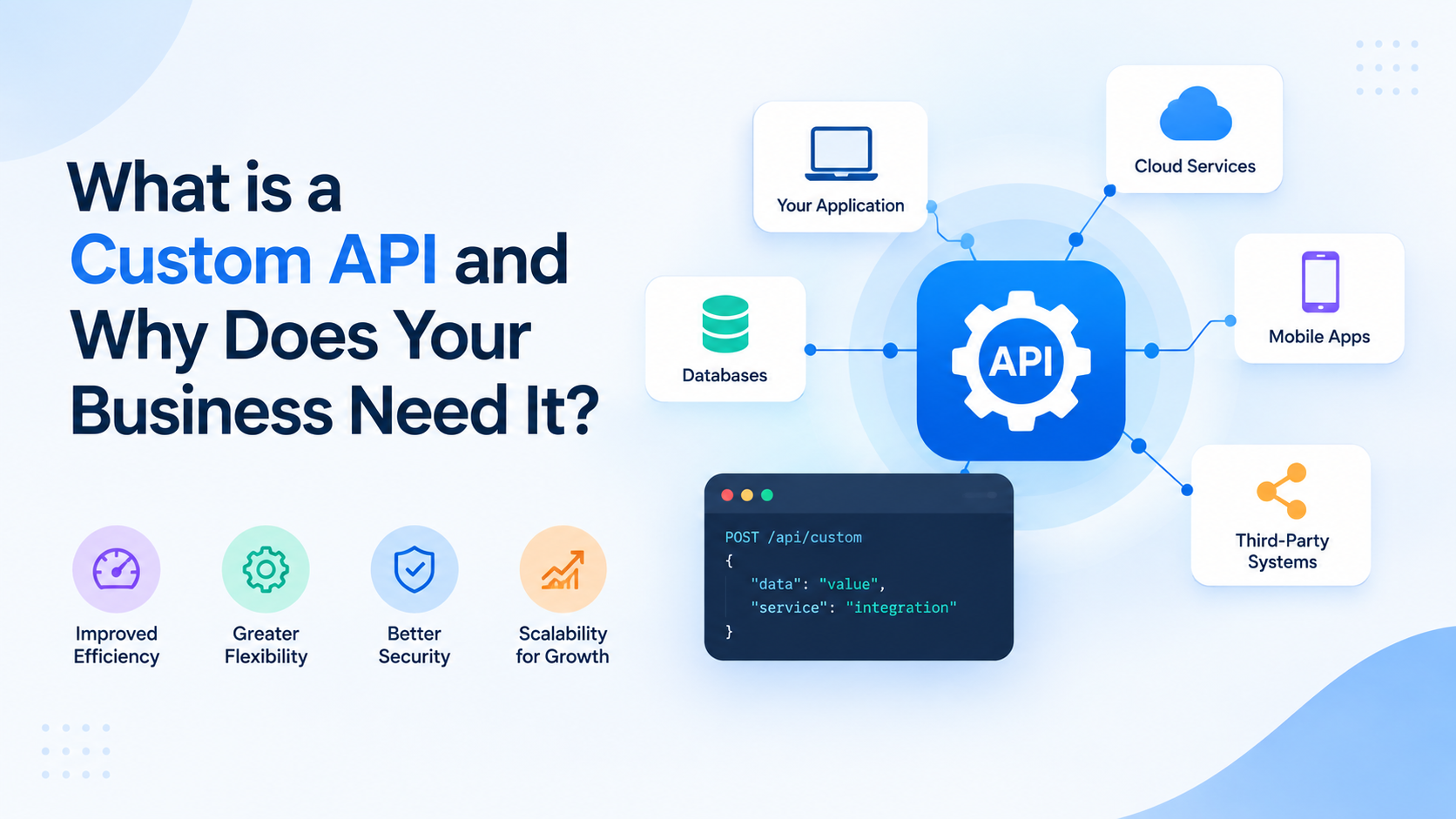

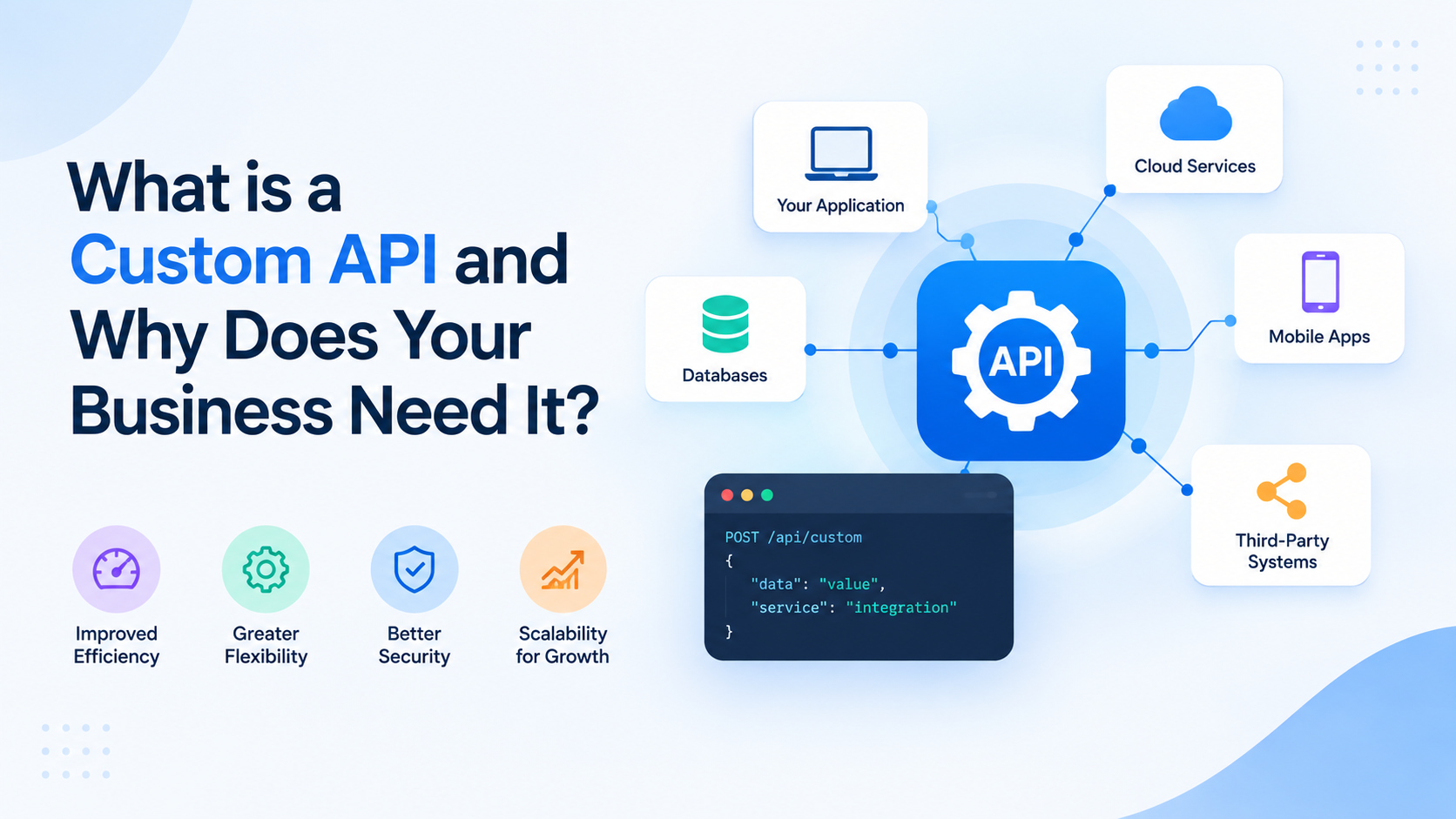
To streamline operations and deliver a better customer experience, enterprises must prioritize effective communication between internal software systems. As modern enterprises increasingly develop custom APIs, they can achieve significant improvements in workflow efficiency and business growth. If you’re wondering how a custom API can make a difference, this review explains how.
In this blog post, we explain what a Custom API is and why your business needs it.
What is a Custom API?
A customized API is an application programming interface designed specifically using an organization's own data, workflows, business rules, and application requirements. Instead of working with a product or internal system that provides basic functionality, a prebuilt API happens to provide a controlled interface that your business needs.
For example, a company may have a CRM, ERP, inventory database, and service portal, each holding crucial customer information. With a custom API, a business can define how those systems exchange data, validate requests, and handle customer data better.
As API becomes a solid platform between systems, they allow applications to operate in unison without requiring every connected application to understand the internal architecture. Custom APIs can be designed using approaches such as REST or GraphQL, depending on the data model, interaction pattern, and consumer requirements. Their importance is not simply in connecting systems. Their value comes from shaping that connection around a specific business requirement.
Why Does Your Business Need a Custom API
Businesses that follow old application formats always find difficulty in sharing and handling their customer data across the organization. With a basic packaged connector linking basic records, it will fail to handle organization-specific approvals, calculations, validation rules, data transformations, or multi-step workflows. So, the business will make developers compensate with scripts, duplicated logic, manual exports, or tightly coupled point-to-point connections.
A custom API offers businesses a stable interface around those requirements. Instead of allowing applications to connect directly to back-end systems, the API centralizes the business rules and exposes only the data and actions inside a system.
A website may need customer status from a CRM, order information from an ERP, inventory availability from a warehouse system, and payment status from another service. A custom API can structure these interactions into a predictable experience for the website or mobile app, reducing the need for developer dependency.
Moreover, custom APIs are also useful when a company is turning internal capabilities into reusable services. The team can access a customer-verification endpoint, pricing service, document-generation function, or case-creation workflow that can support multiple applications, replacing individual structure creation.
Use Cases of Custom API
By creating a customized workforce and connectivity, custom APIs become valuable for internal teams. A business can connect CRM, ERP, HR, finance, inventory, or service-management platforms through APIs that transform data into a shared structure and create organization-specific rules. This reduces the need for employees to re-enter information across systems and automates data movement.
Another better use of an API is in customer and partner applications. A company can build a customer portal to store and view account details, submit requests, track orders, download documents, or receive status updates of a customer journey. With a custom API on their side, they can easily expose operations that the portal requires and avoid giving the application broad access to underlying databases. This is also found useful for support supplier portals, reseller platforms, and partner integrations.
Besides streamlining the data workflow, a custom API helps in workflow automation. For example, consider an employee onboarding process that must create a user account, assign equipment, open service tickets, update HR records, and notify managers. Using a custom API, the team can easily coordinate these actions that works similar to an automation platform's calls.
Moreover, by offering better stability and management support, Custom APIs have proven to be a key to modernizing legacy systems. Companies that run on old applications can contain valuable business logic but lack smart technological interfaces suitable for modern web or mobile applications. An API layer can expose selected capabilities without requiring the entire legacy platform to be replaced immediately.
Benefits of Custom API
As we saw the use case and why a business needs a customized API, let's see some of the benefits it offers in the following:
They Are Customized to Your Business Requirements
A custom API is completely built based on your business workflows, data structures, validation rules, and operational requirements. By replacing a generic API with a personalized one, you can create endpoints that support exactly what your applications need.
Seamless System Integration
By empowering connectivity, a custom API helps you connect CRM, ERP, databases, customer portals, mobile applications, and third-party platforms through a consistent integration layer. By this, it reduces isolated connections and enables applications to exchange information without relying on repetitive manual processes.
Better Data Accuracy and Consistency
When employees share data between systems, they can find duplicate records, outdated data, and entry errors. With a custom API, businesses can automate data exchange and apply validation rules before the move to help maintain data reliability across systems.
Greater Security and Control
Custom APIs allow businesses to define who can access specific resources and what actions they can perform. By implementing authentication, authorization, input validation, access controls, logging, and other security mechanisms, API architecture provides greater control over sensitive business data.
Easier Scalability and Maintenance
As applications and business requirements grow, coupled integrations can become hard to maintain. A personalized API creates a stable interface between systems, allowing applications or back-end components to evolve with less disruption to connected services.
As we walk through the capabilities of a custom API, businesses find it helps streamline and offer better rules in workflows. With modern organizations moving towards custom API, they find them more scalable and reliable, bringing structured discipline rather than a luxurious tool.
Looking to explore more about API and other software-related content, visit our blog pages to know more.
{
"@context": "https://schema.org",
"@type": "Article",
"@id": "https://sgstechnologies.net/blog/custom-api-business-need#article",
"mainEntityOfPage": {
"@type": "WebPage",
"@id": "https://sgstechnologies.net/blog/custom-api-business-need"
},
"headline": "What is a Custom API and Why Does Your Business Need It?",
"description": "Learn what a custom API is, how it connects business systems, and why businesses use custom APIs for integration, automation, security, scalability, and data consistency.",
"url": "https://sgstechnologies.net/blog/custom-api-business-need",
"datePublished": "2026-09-23",
"dateModified": "2026-09-23",
"author": {
"@type": "Organization",
"name": "SGS Technologie",
"url": "https://www.sgstechnologies.net/"
},
"publisher": {
"@type": "Organization",
"name": "SGS Technologie",
"url": "https://www.sgstechnologies.net/"
},
"articleSection": "Software Development",
"keywords": [
"Custom API",
"Custom API Development",
"API Integration",
"API Development",
"Business API",
"Software Integration",
"Custom Software Development"
],
"inLanguage": "en-US"
}
</script>