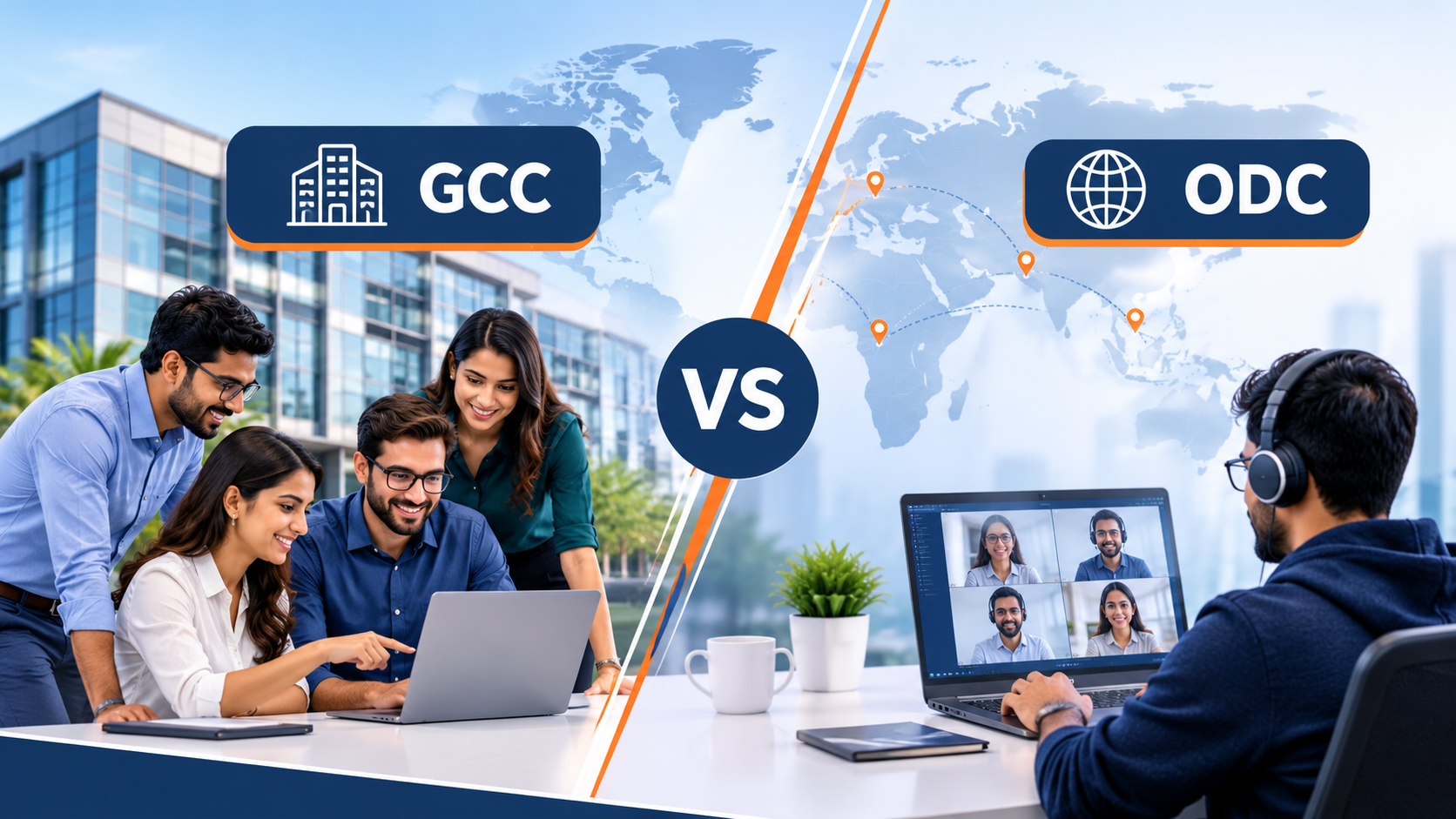















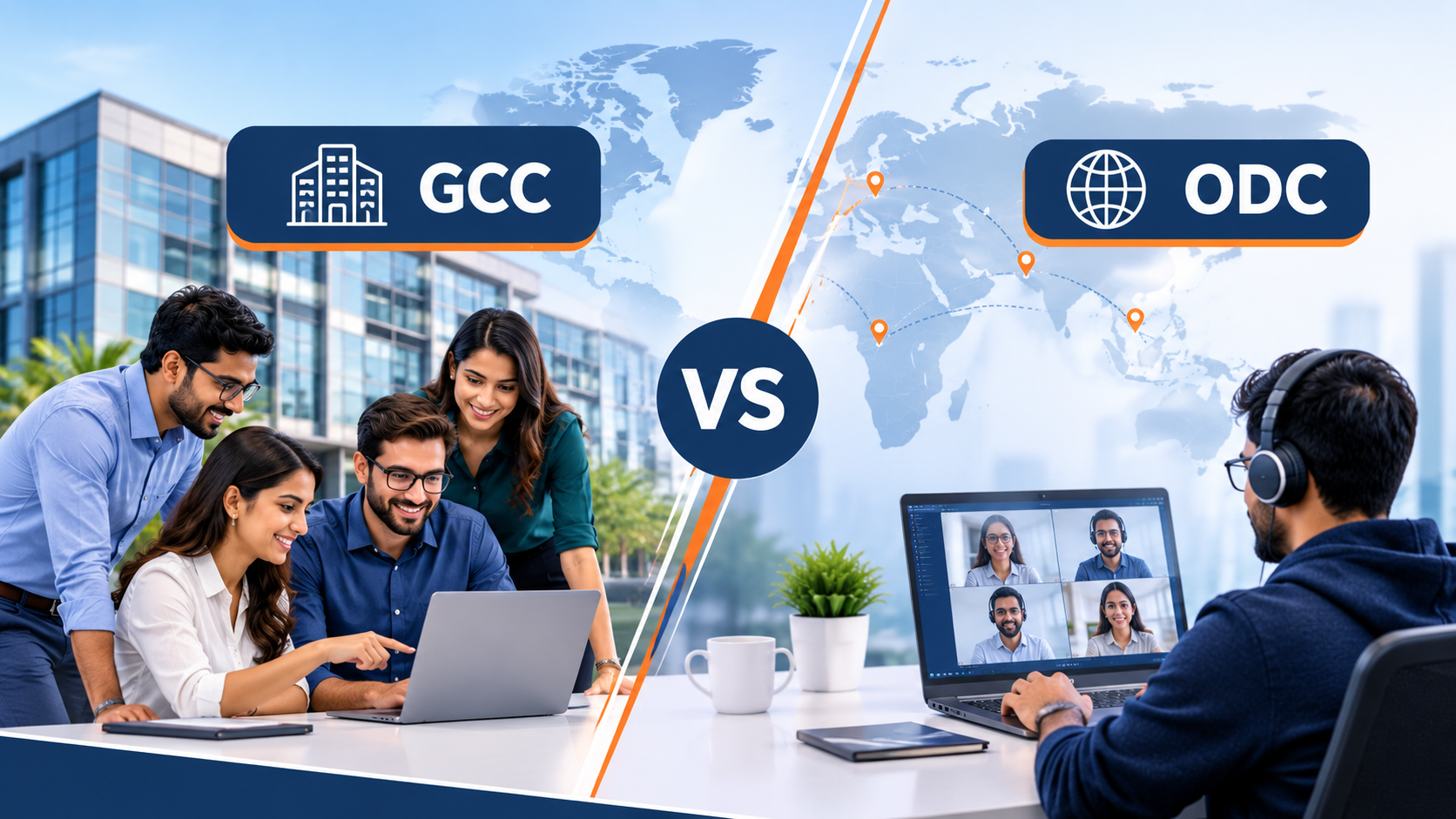

Most companies that look at building engineering capacity in India start with the same question: do we set up our own Global Capability Center (GCC), or partner with an Offshore Development Center (ODC)?
Both models give you access to deep talent, round-the-clock productivity, and meaningful cost efficiency. But they differ in ownership, speed, control, and commitment. Choosing the wrong one can mean years of wasted investment or a team that never quite fits your business.
This guide breaks down both models so you can decide which one fits where your company is today.
What is a Global Capability Center (GCC)?
A GCC is a company-owned offshore unit, a captive center that operates as an extension of the parent organization. It is staffed by your own employees, governed by your policies, and aligned to your roadmap.
GCCs have evolved well beyond their back-office origins. Today many handle product engineering, analytics, AI/ML, cybersecurity, and R&D, functioning as true centers of innovation rather than cost centers.
Key characteristics:
1. Full ownership of the entity, people, IP, and processes
2. Direct employment of the team
3. Long-term, strategic commitment
4. Deep integration with global business functions
What is an Offshore Development Center (ODC)?
An ODC is a dedicated team of engineers, hosted and managed by a service partner, that works exclusively on your projects. The team feels like yours: they attend your standups, follow your processes, and own your deliverables. But the legal entity, infrastructure, hiring, HR, and compliance are handled by the partner.
Key characteristics:
1. Dedicated team, delivered through a partner
2. Partner handles recruitment, infrastructure, payroll, and compliance
3. Flexible scaling up or down
4. Faster setup with lower upfront investment
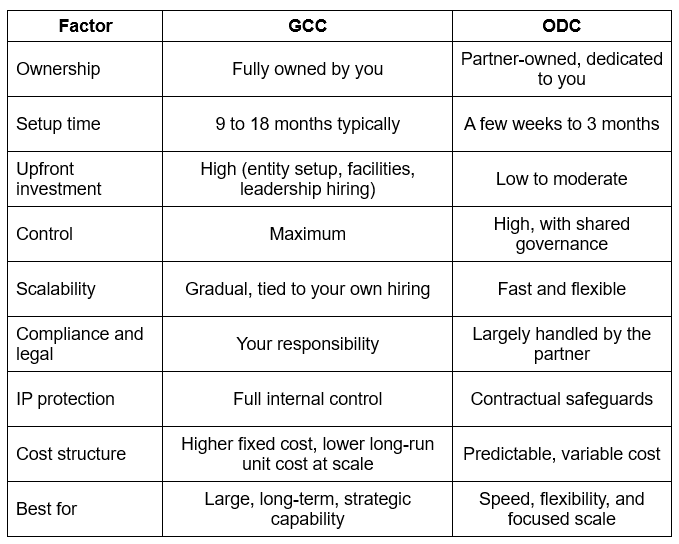
GCC vs ODC: Side-by-Side Comparison
When a GCC Makes Sense
A GCC is typically the right call when:
1. You have a long-term horizon. You're committing to India as a strategic hub for five to ten years or more.
2. You need large scale. Hundreds of engineers across multiple functions justify the fixed investment.
3. Your IP is highly sensitive. Core product, proprietary algorithms, or regulated data demand full control.
4. You want to build culture and leadership. You're looking to develop a center with its own leadership, brand, and career paths.
5. You have the internal bandwidth. Your leadership can handle entity setup, hiring, real estate, and ongoing operations.
When an ODC Makes Sense
An ODC is usually the stronger fit when:
1. Speed matters. You need a productive team in weeks, not quarters.
2. You're testing the waters. You want to validate India as a location before making a heavy commitment.
3. Your needs are specialized or fluctuating. Project-based or skill-specific demand favors flexible capacity.
4. You lack local presence. You don't have the team, entity, or expertise to hire and operate in India.
5.You're a growth-stage or mid-size company. The full overhead of a GCC would outweigh the benefits at your current size.
It's Not Always Either/Or
Many successful companies treat this as a journey rather than a binary choice. A common path:
- Start with an ODC to launch quickly and prove the model.
- Scale the team as the business case strengthens.
- Transition to a GCC through a Build-Operate-Transfer (BOT) arrangement once scale and strategy justify ownership.
The BOT approach lets you de-risk the early stages while keeping a clear path to full ownership, with the partner handling the heavy lifting until you're ready to take over.
Five Questions to Ask Before You Decide
1. How quickly do we need a working team?
2. How many people will we need in 12, 24, and 36 months?
3. How sensitive is the IP and data involved?
4. Do we have the leadership bandwidth to build and run an offshore entity?
5. Are we optimizing for flexibility now or for ownership over the long term?
If your answers lean toward speed, flexibility, and lower risk, an ODC is likely your best starting point. If they lean toward scale, control, and long-term strategic value, a GCC deserves serious consideration.
Conclusion
There's no universally better model, only the one that fits your stage, goals, and risk appetite. The right choice today may not be the right choice in three years, which is why a partner who can support you across the full spectrum, from ODC to BOT to GCC, is often more valuable than one who pushes a single model.
Talk to our team about the model that fits your roadmap.